Everybody knows those scenes from the movies where the hero is trapped in a room with a bomb and he is given instructions through the phone on how to disarm that bomb, while it slowly ticks down. Have you ever thought how it feels to be that guy ?
Think no more. Keep Talking and Nobody Explodes will make you feel just like him.
If you often have gatherings with your friends and you enjoy playing games that will make your brain explode, this game is just perfect for you. You will find yourself disarming a suitcase bomb with multiple modules that only you can see, while trying to describe these modules to other players who have a manual which gives instructions on how to disarm them.
The player defusing the bomb is placed in a room where he can rotate the briefcase with the bomb to see the modules and look for important details that may give hints on how to disarm them. The modules can range from pressing buttons, cutting colored wires to memorization and Morse code reading. The main game includes 33 bombs to disarm, each harder than the last one, but you can choose to try free playmode which has an infinite number of bombs with random modules attached.
The difficulty of the game depends on how familiar you become with the modules. The earlier bombs will not be too difficult to beat, even for a first-timer, but the later ones will require experienced players. Sometimes you will need more than one person to help you with instructions from the manual, so I recommend gathering a group of friends and keep some pens and paper close as you go through the bombs. The manual can be used in many ways: you can read it on a different computer, making sure that the bomb defuser doesn't see it, or you can swipe through it on your phone. For a more authentic experience and more adrenaline, I recommend printing it.
The game can also be played on Oculus Rift. The most noticeable difference is that playing on the Rift makes it easier for those reading the manual to keep from looking at the screen to see the bomb, while also the same computer to read it.
I recommend trying Keep Talking and Nobody Explodes together with your friends, you will constantly feel adrenaline rush through your veins and you will be sweating bullets. Your mind will be blown.
Name: Keep Talking and Nobody Explodes Developer: Steel Crate Games Publisher: Steel Crate Games Released: October 8, 2015 MSRP: $14.99
This review is coming later than it should, because Crawl has been around for quite a while already. If you're reading this and you're surfing Twitter often, there is a great chance you have heard of Crawl already, or at least you've seen some of it's wonderful pixel art and GIFs all over Twitter.
Crawl is that game you might remember having played a few months or years ago, with your friends, at some party or on some random night out. The game has been around in a pre-release state since 2014, but its "full release" version has been around for less than a week.
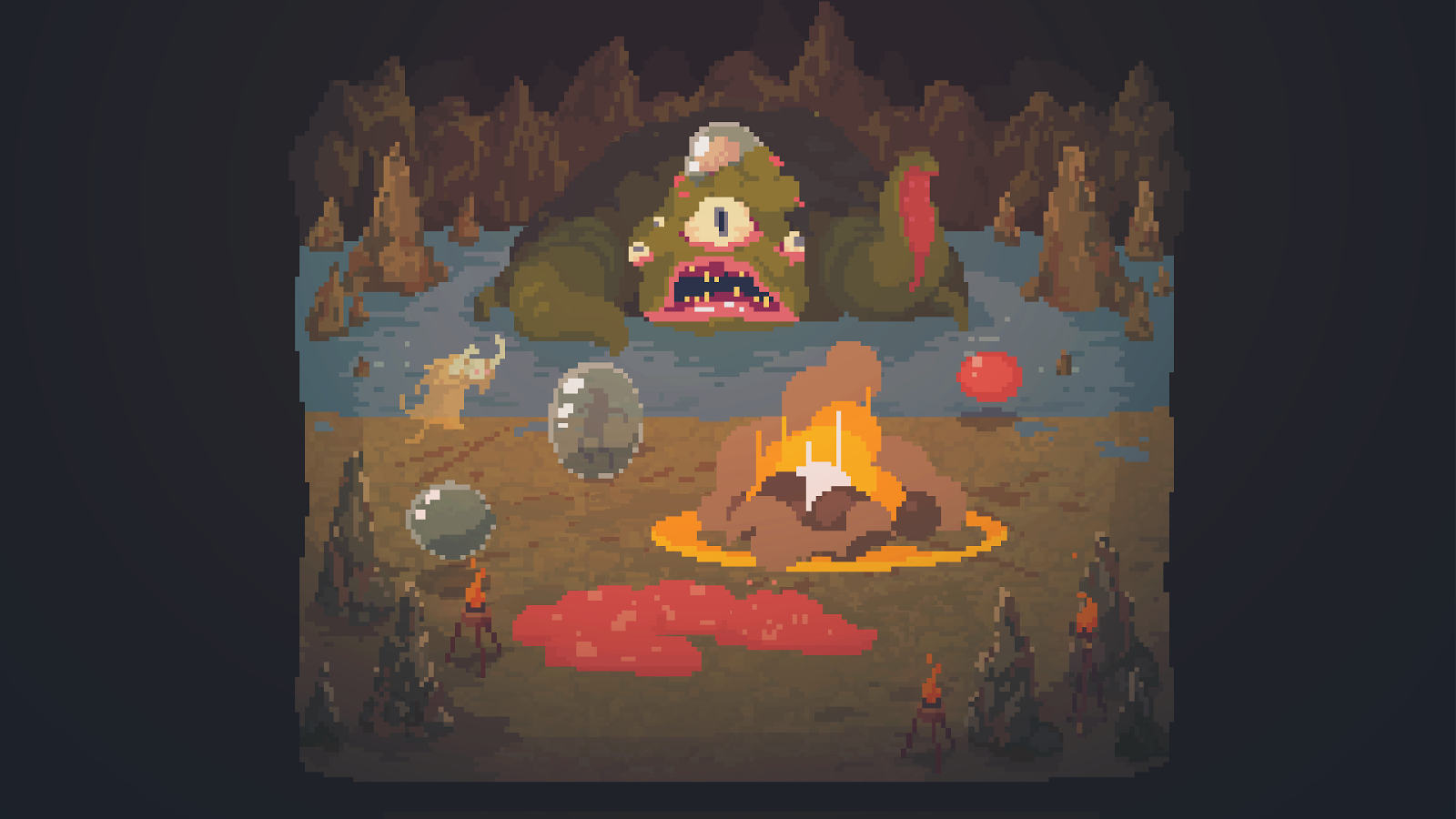
Crawl is a local multiplayer dungeon-crawler where you and your friends take turns playing as either the hero or the monsters. Not in a pass-the-controller-to-the-next-one kind of way, but in a kill-the-hero-and-become-him-and-then-try-not-to-get-killed-yourself kind of way.
The atmosphere in Crawl is filled with murder, betrayal and madness. After the narrator finishes his speech during the intro, the four human players are left to fight each other with knifes and clubs until only one emerges glorious from the fight. He will be the hero who will wander the dungeon alone.
As the hero, you do the same dungeon-crawler things you do in other games of this genre: explore rooms, dodge traps, loot gold which you can use to buy new equipment, spells, and items. You level up as you gain experience by defeating monsters, you can drink strange potions to get stronger, and you can do many other things that you can also find in other games of this genre.
But wait a bit. I said "four human players" earlier, but there is only one hero. Something is strange here. What happens to your three friends if you manage to beat them ? What happens to you if one of them beats you ? Well, you become a ghost.
Yes, you've read it well. You become a ghost. That's where Crawl overtakes the other games of this genre: while one of you and your friends becomes a hero, the others have to stop him from becoming stronger and from going deeper in the dungeon.
Ghosts can not directly harm the hero, as in hitting him, but they can do other things to do so. They can possess any random trap and trigger it at the right moment to harm the hero. Or they can haunt some random chair or pot to hurl at him. If you're the fighter kind, ghosts can possess summoning sigils found throughout the dungeon and reincarnate as a random monster predetermined by whatever deity you selected at the beginning. From a slimy slug to a fiery dragon, there are lots of creatures you can reincarnate as. Kill the hero and you will have your humanity restored. But, only if you deal the last hit.
This is what makes Crawl one of the best games to stay up late yelling at your friends. The constant rotation of your teammates as the monsters working together to bring the hero down and the competition to get that last hit, and then the mad hunt for the new hero.
In addition to the gold you gain while being a hero, there is a secondary currency in the game, called Wrath. You gain Wrath while playing as a monster, according to how much damage you dealt to the hero on every floor. You then use it to upgrade your monsters after the current floor ends. This way, the person who played as the hero the least will always have access to the strongest monsters, and the player who got an early lead as the hero will face hard times after the other players catch up and upgrade their monsters.
Each monster has two defining moves. They are usually some kind of direct attack combined with either a dodge move (bat demons will fly away, retreating, while slugs will dive into the earth and reappear elsewhere), or some kind of obstacle or hazard (pools of acid vomit, walls of flame, etc.).
The balance doesn't always seem right between the monsters, though, and that's something you might expect from a cast of 60+ creatures with unique skills. There are some monsters that are just too powerful and easy to use that they completely overshadow the others.
However, heroes are not completely powerless. The variety of weapons and items you can find and use is insane. Ranged weapons such as bows and slings can help against the most annoying monsters, at the cost of damage. Spells like floating lasers or cursed blades that summon giant swords from the sky can ruin a monster's day immediately. Yet, even some items seem underpowered compared to others.
All this fighting leads to the final confrontation: the boss fight. When a hero reaches level 10 or higher, they can activate a portal and face the boss in order to escape victorious from the dungeon. Or not.
The bosses in Crawl are giant creatures that can be controlled by each of the three ghosts. Or at least parts of them. One player will take control of an arm, a head, a tentacle or a giant eye and use it to bite, crush or burn the hero. Survivors who make it out will unlock extra items and evolutions for their monsters. Losers who have the courage to challenge the boss three times and still fail will have their humanity removed from them and their three-initial name deleted from the recorded history.
Even if you are playing alone, without your friends trying to kill you, you can still choose to play with A.I. players. The game allows for A.I. players and they do a great job at trying to make your run as hard as possible. There are challenge modes to unlock and compete for every monster, achievements to undertake, a massive vault of items and Easter Eggs to search for. Have you found the Gaben statue ? If you have the bad luck to be the hero and one ghosts decides to possess it, you're gonna have a bad time. Good luck killing him.
Good things take time, and so Crawl's full version did. After spending a long time in pre-release state, the results speak for themselves. Crawl is probably the best dungeon-crawler game to play with your friends if you want a competitive atmosphere, defined by betrayal and murder.
Set in an '80s-inspired world where magic is commonplace, Megamagic: Wizards of the Neon Age is a bright, vibrant RPG, where people got magic powers thanks to a strange meteor that crashed thousands of years prior. Matters of magic are governed more or less by The Order, which also trains up-and-coming wizards like Phoban, the young protagonist, and his brother, Deimos.
The game ensues a save-the-world kind of adventure fit for a Saturday morning cartoon, with the goofy humour that goes with it. It's not deep nor innovative, it may have some pacing issues, but it's a whole lot of fun - and that's something I think devs often fail to give thanks to their rush to have their video games "taken seriously".
That sense of fun flows through the whole game, from its delightful synthpop soundtrack to its colourful and cartoony aesthetic, which will appeal a lot to the children of the '80s (or at least to people familia with the '80s pop culture). Just like Far Cry: Blood Dragon, Hotline Miami, and Grand Theft Auto: Vice City, Megamagic celebrates that era, but with perhaps a bit more referential humour than some would like.
You start out in Grove Valley, a quiet little suburban town with a weird number of parked DeLoreans, and you are soon summoned by your scientist friend, Zemec. Your journey will take you through a Mad-Max inspired desert wasteland to Camp Miller, home to a clan of punks, and a clear homage to Tron. There you will encounter a swordsman who believes that you are his father's killer, and insists that you should prepare to die.
Armed with a staff, the ability to summon creatures called Grims, and a growing number of magic spells, you'll fight against zombies, rodents of unusual size, punks, temple guards and techno rangers, and the key to not getting torn to pieces is to never stop moving. Stand still and you'll soon get swarmed and die.
At the beginning you're armed with a simple projectile spell, but as the game advances, you will learn more things, which will open your tactical options dramatically: a black hole that sucks your enemies in; a cone of wind that knocks them back; a pool of mud that slows them, and exploding skulls that work as landmines.
There's a lot of synergy between your spells, and success in this game means learning to make the most of this synergy, in order to deal maximum damage. One very useful combo is using a black hole to trap enemies inside an electromagnetic field, while you are your army of Grims throw magic projectiles, while staying at a safe distance.
However, it is very easy to lose track of what's happening and get lost in the chaos. The respawn rates of your enemies are very fast, and you will often find yourself fighting multiple similar groups back to back. Sometimes enemies will even attack you from off-screen, so you should expect to die randomly and frequently - and this is just the Easy difficulty.
Even though the game is an RPG, it is fairly light, with no leveling or stat management to deal with. Instead, the game focuses on learning new spells, which involves finding scrolls with said spell somewhere in the world and then gathering the required magical items - dropped by enemies or found in chests - to craft it.
Summoning spells for Grims work differently - these spells mirror the monsters you'll encounter in the wild, and you need to kill a set amount of the enemy in question, while also witnessing all its special moves, all before you'll be able to craft it in the same manner as the standard spells.
Visually, Megamagic is stunning. The art style matches the ’80s theme very well. The colours are bright and pop out at you. The level design varies nicely; with bright blue cubic levels, to the dusty desert – there are plenty of beautiful and varying levels to stare at.
As well as the great visual style Megamagic has, you are treated to some great tunes to join you on your adventure. From Hotline Miami 2 and Kung Fury soundtrack composer, Mitch Murder, the soundtrack only magnifies the whole ‘80s experience.
While being a bit rough around the edges, the game is still charming and special nonetheless. It's a nostalgic trip through a magical '80s world, fueled by a wonderful soundtrack, bright colours, and great humour, that will certainly make you feel like being part of that era.
Name: Megamagic: Wizards of the Neon Age Developer: BeautiFun Games Publisher: BeautiFun Games Released: April 20, 2016 MSRP: $9.99
Train Valley is a nice indie game that's easy to learn but hard to master. The early levels are extremely simple, but the difficulty goes up really quick and you will soon find yourself struggling to complete all the objectives. You will use the Pause button more than you'd think.
The game has two modes: a classicmode, which is a series of objective-based scenarios that take place in the United States, Japan, Russia, and Europe, throughout the 19th, 20th and 21st centuries, and a sandbox mode. The levels do not actually take place in those locations exactly, but in geographical approximations of these places.
For example, Florida, which is the third level of the second area, is represented as a coastal environment that offers unique challenges for your design due to the bottleneck effect of the map's terrain. You will be forced to map your design around two tunnels and a bridge in order to travel across the landscape.
The first level plays the role of a tutorial, it tells you the basics, how to build rails and how to move your trains, and it tricks you into a false sense of security about how relaxing and easy this game will be. Don't be fooled though.
As you make money, existing stations will expand and form cities around them, and new stations will pop up on the map. Connect these stations to your existing rail systems and you will have the oportunity of sending more trains around the map at any given time. Diverging rail lines need to have their tracks manually switched by the player before the train reaches the exchange.
However, misaligning just one track switch can have hazardous results: your train will end up in the wrong station (which will cost you precious money), or even worse, it could end up hitting a different train, ending in an explosion that will destroy the tracks nearby. If you don't have the money to repair the track, this can lead to isolated stations, which will also cost you serious money if your trains can't reach their destination.
Terrain is the only obstacle at the moment. Some terrain features are impassable, such as volcanoes, hills, rivers, while others can be built through at a cost (villages, forests). While you have directional control over where your tracks go, the game lacks elevation.
For instance, if you have a body of water in your way, your only escape is to path your tracks around it, because there are no options for bridge-building, tunneling or any form of elevated construction. This may make the game seem a little poor in content, but it's not a game-breaking thing.
The second mode is an open sandbox mode which lets players build train networks across the same maps as in the classic mode, but without the loss conditions or resource management (money is gone). This mode is only available for every map that is completed in classic mode and mirrors the set-up of each map.
The Germany DLC adds new levels to the game, adding a new area to the campaign. The game becomes even more challenging, since the DLC adds new unexpected conditions to the game, like biplane bombing or a super-train express moving across the map.
Train Valley is a perfect game for those evenings when all you want to do is lay down on the couch and play a quick game. It's not very expensive, and for $9.99 you can't really go wrong. If you are into challenging puzzle games witch nice graphics, this is certainly the game for you.
P.S. The devs announced a sequel.
Name: Train Valley Developer: Flazm Publisher: Flazm Released: September 16, 2015 MSRP: $9.99
A young boy named Elian dreams of more than serving drinks and heads out for a life raiding dungeons and getting sweet loot. He meets a few friends along the way, including an accountant dwarf and a sneaky minstrel, and they form a band to go on adventures and find more loot.
The gameplay consists in exploring a dungeon and fighting in it while doing missions. The exploring takes place on a top-down “board”. Each room is a single square and every turn your party moves to the next square chosen out of up to four directions.
You reveal the map as you explore but unless you use special powers, like Elian revealing two squares in each direction or Thorgrim identifying a treasure or event spot, you have no idea which way heads to treasure or leads into certain doom.
Every move is a risk, and that’s both stressful and exhilarating. It’s basically exactly what Dark Souls taps into to keep people playing, except Dungeon Rushers does it with a smile. Traps can be overcome but only if you have the finite resource that is stamina, event locations can either be a blessing or a curse, and there could be enemies waiting on the very next square but you’ll never know until you move.
The combat is very classically turn-based, the order decided by what level a character’s Speed is. Each character takes a go with a straight attack, a special attack that uses Mana, an item, or Guard. Heroes and Enemies each get two rows, and only ranged weapons or magic attacks can reach the second row until one enemy in the front row gets defeated.
There is no avoiding getting hit so winning just involves outlasting the enemy. This wouldn’t be so bad except that health potions, like all other items in the game, are finite. You can only buy one from the shop between missions and if you’re lucky you might either be able to craft one or find a healing event in the dungeon, but otherwise you can only face a certain amount of battles in a level before you die and have to play the whole thing again.
One remarkable part of the game is the easy-to-use level editor, which is rather neatly built into the main game. After a few levels a short dialogue plays where Thorgrim suggests that building their own dungeon would be a good way to earn some extra coins. I can’t say I ever got any money for my creations, but making a dungeon was strangely addictive.
Secret doors, red herrings, different types of loot, keys, password-encrypted doors, even different types of dead end are available for you to customize. Then, at a click, you can upload it to Steam Workshop or easily overwrite it if you tweak it later.
The game also has DLC available, which adds skins to the game, letting you change the appearance of your heroes. At the moment of writing this review, there are two skin packs: the Veterans and the Dark Warriors, and a third one has been announced for May 2017, the Pirates Skins Pack.
Dungeon Rushers is the type of game where you want to continually press on and find the new exciting thing in the next dungeon, not to mention some more excellent funny conversations. That’s fun. You do not want to make all the right moves then find yourself up against an unbeatable group of foes.
Name: Dungeon Rushers Developer: Goblinz Studio Publisher: Goblinz Studio, WhisperGames Released: September 6, 2016 MSRP: $14.99
Picture the setting, you're a newly turned oil hunter in the early US Western frontiers, with money on the brain and a need to get in on the rush. To fulfill this need, you travel out to the virgin ground near one of the fledgling towns and decide that there is just as good a place as any to start getting rich. Of course, becoming a successful, loaded oil baron isn't as easy as other people made it out to be.
Turmoil is all about mining for oil, just in case you hadn't got that yet, and trying to make more money over the course of the campaign than any of your three rivals. It's brilliantly simple in its execution, very easy to pick up and actually incredibly addictive once you get into the swing of things.
You'll start off with ten thousand dollars to use for your operations, as will your competitors, at the beginning of the campaign. Every level requires three thousand dollars to play because you spend a minimum of one thousand actually buying the land in an auction before the level starts, then an additional two thousand on actually going to the site and digging.
Before even starting to drill down, a dowser is needed to 'locate' the oil. These guys are diligent, I'll give them that, however, they take their sweet time finding any oil spots when you've only got four months (ten minutes) to get as much money as possible. Also, there's a serious issue with them finding oil on top of a structure, because you can't build on stuff that's already there, nor can you destroy buildings.
But when you find your supply of black gold, you can finally get things under way. Using a combination of multiple silo's and wagons, you move the oil from either the drill pump to storage, or from storage to the Left and Right Inc merchants. Just avoid spillages, as they cost $600 a pop.
This is one of the more interesting mechanics, the additional of two opposing houses means you're able to weight their prices against each other, forcing you to constantly switch from one to the other in order to gain more profit.
Basically, it's pretty intense in the earlier stages because you need to break even to continue properly. Once you begin completing each dig site, which lasts about five to ten minutes in real time, you'll start to see that other people have set up shops back in your hometown. These townsfolk offer a variety of upgrades for your operations.
For example, the inventor gives you access to faster dowsing or deeper dowsing scans, which allow them to detect oil at greater levels. All in all, these upgrades are a sure way of making your oil harvesting way more efficient in the long run.
After you've unlocked the Saloon and you've got a few upgrades under your belt, you will probably start to hit big money. It helps if you are smart too, as each site will be graded from one, being terrible, to fifty, meaning amazing, after a person has dug there. Try to pick one that may have a higher number, without attracting the attention of the other players.
If you've got the knack for managing three separate drills with twenty wagons all moving round to sell your oil at the highest prices at the nearby Left or Right factories, then you can make ridiculous amounts during a single round.
Turmoil succeeds brilliantly at being a unique, engaging title that really envelops players once they start to hit it big. Aside from the smaller flaws surrounding the repetitive nature of tasks given and the fact that you can't destroy your own structures in place of new ones, its design and creative ambience is undeniable.
The basic premise behind Risk of Rain is simple: explore a randomly selected level, find the exit teleporter, fight off a huge wave of aliens, and then repeat until death inevitably shows up. Killing enemies along the way nets money and experience, the former of which can be used to purchase a random smattering of the hundred or so items available.
What throws a wrench into it all, and really sets the tone for the whole experience is a timer in the top right corner of the screen, constantly counting up. As time passes, the monsters that spawn become more powerful, able to take and deal more damage. The timer sets up a risk/reward scenario in which the player can be cautious and thorough, gaining as many items and as much experience as possible before taking on the boss and moving on, at the cost of having to face more formidable enemies.
The result is an environment that rewards a balance of exploration and speed, causing the player to be in a frenzy at all times. Even when no aliens are on screen and actively threatening murder, there is an aura of tenseness in knowing that dawdling too much will cause the eventual monster spawns to be insurmountable.
This all takes place in environments that are kind-of-sort-of randomly generated. The levels themselves are pre-built, with several possible levels available to be randomly selected for each stage. Within those randomly selected levels, the entrance, exit, item locations, and monster spawns are all randomized, so no two plays on any given level are identical, and runs can vary widely in which levels are selected.
Somewhat ironically, the constant variation makes individual runs with a given character feel quite similar to one another. Since the player can never know where exactly to go, it is always a frantic search that can be fraught with the bad luck of having chosen to explore in the wrong direction, or the fortune of stumbling upon the teleporter early.
Though each run with a given character feels similar to previous runs with that character, gameplay changes drastically depending on which character is in play. The default is a Commando, who is highly mobile and has good range on his attacks, but can typically only affect one enemy at a time. In contrast, the Enforcer is much slower and focuses on crowd control, able to knock aliens back and attack with a small area of effect. In total, there are ten different classes to choose from, but only after unlocking each.
Risk of Rain includes online multiplayer for up to four players, or local multiplayer for two. In some ways, the multiplayer is easier, increasing base firepower right from the beginning. As the game progresses, it becomes even more difficult, as neither experience nor items are shared between players. As with the single player, once a character is dead, he's out for good. So while playing with friends is potentially more entertaining than going it alone, sitting and waiting while your friends have all the fun is not quite so good.
Graphically, Risk of Rain delivers above average pixel art, although the tiny player models take some getting used to. The aliens are the real stars, and they are well drawn and animated. The sound design is excellent, with the soundtrack portraying the antagonistic alien worlds fantastically. During one emergent instance, I was killed and thrown off a tall tower, falling several screens just as a musical crescendo hit, creating an incredibly dramatic scene that I will remember for a long time.
All things considered, Risk of Rain is a lot of fun. It has the right stuff to elicit the "just one more run" response that roguelike games are known for. With a little more polish, it could be truly great, but as it is now, it's still totally worth checking out.
Name: Risk of Rain Developer: Hopoo Games Publisher: Chucklefish Games Released: November 8, 2013 MSRP: $9.99
Cook, Serve, Delicious is a hardcore cooking sim that recreates the daily tasks of a busy restaurant through keyboard command prompts. You will have the opportunity to take over the restaurant, starting off with a few thousand dollars, 20 different foods to serve up on the menu, a variety of restaurant equipment, and a virtual email account. At the start of each day, a customer will walk in and ask for what they want from the menu you set up. Each order is different, and you must follow their specific requests to avoid them leaving your restaurant unhappy.
After accepting their orders by hitting the corresponding number, you begin the process of preparing meals. If the customer requests a burger with three patties, ketchup, and lettuce, you will start by tapping M, M, M, and Enter to cook three patties on the grill. Once the patties are fully cooked you will be notified, and will have to prepare the burger by hitting M, M, M again in addition to K for ketchup and L for lettuce. Once your burger is finished, hit Enter and serve your customer.
Be careful not to keep your customers waiting for their food for too long, otherwise they’ll grow impatient and leave dissatisfied. You can keep track of your customers by their corresponding numbers. If you haven’t attended to a customer, the bar by their number will gradually recede. The best tip to handling a horde of customers is to take a look at their orders and tackle the ones that need to be cooked first, like hamburgers before a salad. That way, when the patties are sizzling on the grill, you have time quickly serve up a salad or fill up a beverage.
In addition to serving food, you will also be required to complete the restaurant’s daily tasks, including cleaning the restrooms, taking out the garbage, and washing the dishes. You will also be greeted by two rush hours during each open restaurant day, where a large swarm of customers flock to your restaurant. Each rush hour, topped with the increased difficulty of serving your customers, will put your fingers to the test as they fly over the keyboard inputting commands. This is where the game gets tricky, as you will have to gradually remember the prompts for each food item, as you won’t have enough time later on in the game to carefully read through each order.
Cook, Serve, Delicious is colorful and packed with addictive gameplay. Although the game boasts an extraordinary amount of repetition, it avoids feeling tedious and boring. The game’s price point at $10 on Steam is pretty fair for the hours you will put into the game, and even after you defeat the game’s base campaign, there are other in-game activities to keep you coming back for more. These activities include weekly challenges, Iron Chef challenges, and a hardcore campaign mode with brutal difficulty. Cook, Serve, Delicious is a worthy addition to your Steam library, especially when you want to take a little break from competitive gaming.
Name: Cook, Serve, Delicious! Developer: Vertigo Gaming Inc. Publisher: Vertigo Gaming Inc. Released: October 8, 2013 MSRP: $9.99
Crypt of the NecroDancer is a rhythm-based roguelike that demands coordination and perseverance. You control a hero in a grid-based dungeon, advancing in the fog of war step by step as you explore the randomly-generated set of chambers. As you dive deeper you gather gear, spells and consumables to help you survive your fight with monsters who act according to predictable patterns. However, if you die, you will lose everything and you are forced to start over from the beginning.
Unlike in a traditional game of this genre where your greatest asset is the time you afford to think and plan your next movement, in Crypt of the Necrodancer your thinking time is reduced to the space between two beats on the soundtrack. Moving to the rhythm of the music builds up your multiplier and turns the ground into a dancefloor, boosting the gold you earn from every kill. That means you have to keep moving in order to be able to afford the best gear there is. However, if you do not coordinate your moves and you wander around thoughtlessly, you will soon die. What was once a meditative, considered experience becomes now a finger dance.
Each enemy has a different pattern that you'll have to learn, from slimes that bounce back and forth along set routes to shield-wielding skeletons that need to be tackled from the side in order to be defeated. In order to progress further in your adventure and dig deeper into the chambers you need to memorise each pattern and practice enough so countering enemies becomes second nature. This process, however, is slightly dependant on your gear. Different weapons have different attack patterns and your options will be expanded by magic rings, spells and the abillity to dig through walls.
Although in most rhythm games the pattern you have to follow is right in front of you, on the screen, here, the pattern is something you have to feel while listening to the music. The sense that your understanding of the mechanics improves despite repeated failure is one of the most pleasing feelings a game can offer, and the devs made the most of it.
The game is divided between four main worlds, each one subdivided into individual levels. After beating the mini-dungeons of each main world you'll have to fight a clever designed boss in order to advance to the next world. To make progress more reasonable, you can take the worlds one by one, if you'd prefer not to be reset to the beginning every time you die. In the main mode you can also rescue NPCs that sell permanent upgrades and unlock different items that can be found inside chests or in the shop.
As you play, you unlock new characters which fundamentally change the way you'll be playing the game. Dove, for example, can't attack, but unlike other characters, she doesn't have to defeat mini-bosses in order to advance to the next level, having all the exits opened. Bard doesn't need to move to the beat at all and Eli turns NecroDancer into Bomberman with a beat, due to his inability to use regular weapons, but being able to plant and kick infinite bombs.
The game is full of pleasing little touches, from the simple animations for each creature that syncs up with the beat, to the way the shopkeeper sings along to the soundtrack made by Danny Baranowsky, the same guy who composed the soundtracks for Super Meat Boy and The Binding of Isaac. Did I mention that you can use your own music while playing ? The game gives you the option to use custom music, so you can play while moving to the rhythm of your favorite song.
Combine everything said earlier with local co-op, Workshop support, different difficulty options and daily challenges and you have a rhythm-based roguelike with a remarkable long-term potential.
Name: Crypt of the NecroDancer Developer: Brace Yourself Games Publisher: Brace Yourself Games, Klei Entertainment Released: April 23, 2015 MSRP: $14.99
Okhlos: Omega, a world where growing crowds of soldiers, citizens and animals set off to beat the gods and lesser beings from Greek mythology. Why? Because they act like total jerks and the citizens have had enough! Now, I don't think that leveling houses and towns was really necessary, but mobs and collateral damage tend to go hand-in-hand.
Instead of directly controlling individual units, you'll direct where the crowd goes by moving a banner (with your mouse) that your people will automatically gather to. You can issue basic commands for them to attack, spread out, tighten up, or hold steady and block, but there's no fine control of this angry group. The result is chaotic. When you try to squeeze everyone around bombs, spikes and other deadly traps scattered around, there will sure be some casualties.
On the other hand, sending a wave of angry citizens crashing down on a greek god has this great feeling to it. That stays satisfying, which is great, because mechanically there's nothing much else to do in Okhlos.
Each level is broken down into procedurally-generated areas with shops and a boss fight with a god or beast at the end. You'll lose strong people, weak people, you'll pick up wandering replacements, and you'll ocasionally exchange certain types of mob members for others (e.g. slaves for warriors) or claim stat-boosting heroes (like Theseus or Daedalus).
The later ones are especially important to your extended survivability. If your philosopher character dies in battle and you're out of backups, that's the end of your run. Similarly, if your whole mob dies and you can't find any others to build it back up, your fate is sealed.
Being crushed by a god could make it hard to summon the courage to start from the beginning again. The first few stages started to look very repetitive, while Okhlos‘ reliance on luck wasn’t helping matters. A lot hangs on the unit exchange shops, and whether you get offered Heroes or not. Being given a bad hand in this regard is really annoying, as they can be pretty key to success.
There are clearly a couple of elements dragging Okhlos down, what with the controls needing a bit of brain power, and certain bosses leaving me stumped, resulting in repeated sightings of early areas. The majority of the game is really delightful though, with its fun core gameplay wrapped in mythologically-themed packaging that provides a great excuse for some good old ancient humor.
Name: Okhlos: Omega Developer: Coffee Powered Machine Publisher: Devolver Digital Released: August 18, 2016 MSRP: $12.99
When I was young, I dreamt of becoming an engineer, but soon I started working with complex mathematics in school. At that point my brain decided that it simply doesn't want to come to terms with all the calculus and algebraic formulae I had to deal with. That's when I understood that my dream will never come true. Until now. Today, I discovered that anyone can be an engineer, more or less. How? Simple. The answer is Poly Bridge.
Poly Bridge is a bridge-building simulator made by the people at Dry Cactus that will let you unleash your creativity and create wonderful bridges across campaign which has no less than 105 levels. The player's aim is to build a bridge strong enough to get different vehicles safely across a river. In the game's main mode you are restricted by a budget for the materials you are using. You are provided with a variety of materials, such as wood, steel beams, ropes and cables.
10 seconds into the game and you're already building your first bridge. The tutorial does a great job at explaining to you how everything works and how to efficiently manage your resources. After a few minutes, you will find yourself working your way through the campaign levels, figuring how to build a sturdy bridge that will do fine, and often refining it to reduce the budget or make it even more efficient. There are 105 levels divided in 7 areas, each having 15 levels that will take place in a certain environment, specific to the area.
If you ever feel tired of trying to finish a level and you feel like relaxing a bit, you can always switch to the sandbox mode. There you have unlimited money which you can use to build literally any bridge that comes to your mind. You can go wild and create the most complex bridge the world has ever seen, and then if you feel like sharing it with the community, you can publish your design on the Workshop for everyone to try and solve.
The soundtrack made by the canadian Adrian Talens creates a unique atmosphere. The chilled guitar-based music will keep you relaxed during the gameplay, as the levels become more difficult.
Poly Bridge is a game that every fan of the genre will certainly enjoy. It has a high replayability rate, since you can always come back and try to build a cheaper but stronger bridge, or you can go into sandbox mode and build the craziest bridges ever built - your imagination is the limit. For it's price tag ($11.99 at the time this post has been written) the game is incredibly well polished and it can keep you in front of the computer for hours, making you forget about everything else. Even your kids.